
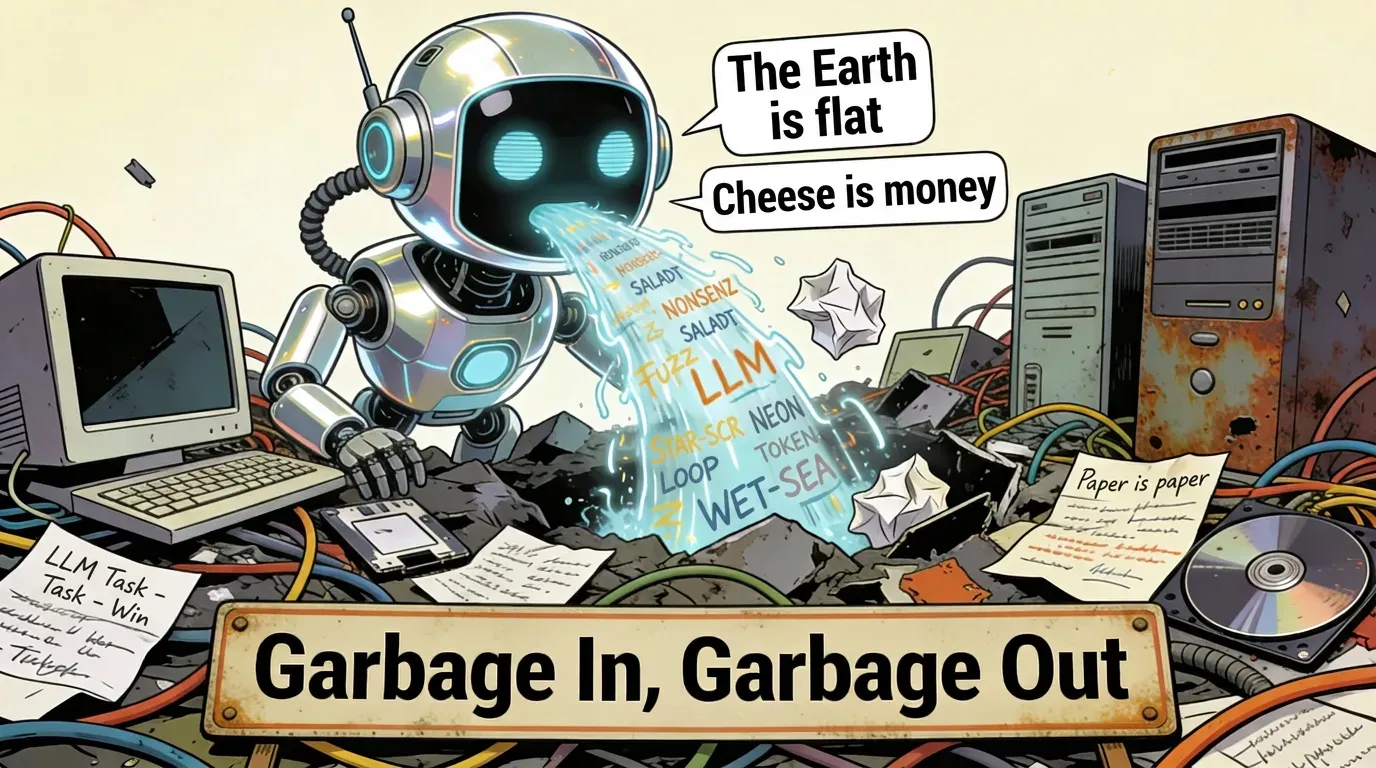
Myth: “We can just plug our data into an LLM, and it will work.”
There’s a common belief showing up in strategy meetings:
“We already have plenty of data, so we can just connect it to an LLM and get value immediately.”
It sounds efficient and modern. In reality, it’s one of the fastest ways to make an AI initiative fail.
The Reality Behind the Hype
Large Language Models (LLMs) are powerful tools, but they are not magic. They do not fix bad data, and they do not automatically understand messy internal systems. An LLM reflects the quality of the data it receives. Clean and well-structured data leads to useful results. Messy and inconsistent data leads to unreliable output. This is where many projects break down.
LLMs Don't Think, They Mirror
LLMs don't generate new knowledge or understanding. They statistically reproduce patterns from training data via next-token prediction. Even advanced "reasoning modes" (like Chain-of-Thought) just simulate thinking through longer pattern chains, not true human reasoning with consciousness or causality. Every response is a probabilistic remix of what they've seen, not true reasoning or world understanding. Token embeddings capture surface patterns, not causal relationships.
No data = no knowledge
Garbage data = garbage knowledge
Even RAG systems only retrieve and remix external data patterns, not create novel insights. Humans generalize from first principles. LLMs only interpolate within their data exposure.
What “Messy Data” Looks Like in Practice
Most companies do not lack data. They struggle with unstructured and inconsistent data.
Typical problems include:
- Different content formats for the same information, such as spreadsheets, PDFs, images, and emails
- Different data formats, such as decimal numbers using a comma or a period, and thousands separated inconsistently, or messy date formats
- Inconsistent naming like “phone”, “phoneNumber”, “number”, and “p”
- Missing or incomplete fields
- Duplicate or conflicting records
- Outdated information mixed with current data
Humans can work around this with effort. Models cannot.
Why Structure Matters
Machine learning depends on patterns. Clean data makes patterns visible. Messy data hides them.
Structured data improves:
- Consistency, so models interpret fields correctly
- Signal clarity, so important information is not buried
- Embeddings, which become more meaningful with clean input
- Retrieval quality in systems like RAG, where better data leads to better answers
A simple way to think about it: if your data is disorganized, your model spends its energy guessing instead of understanding.
The LLM-Specific Risk
With LLMs, the problem is not just lower accuracy. It is misleading confidence. Even with poor data, LLMs still generate fluent and convincing responses.
That leads to:
- Answers that sound correct but are wrong
- Increased hallucinations when context is unclear
- Loss of trust once users notice inconsistencies
The system does not fail loudly. It fails quietly. It is precisely this behavior that makes it so dangerous, because at first, second, or even third glance, it may not be apparent that an incorrect answer is being given. If something contradicts our knowledge, we humans can recognize that the statement must be wrong. But if we have no understanding of the subject we are using the LLM for, we cannot validate the model’s outputs without knowing the underlying data. This is exactly the kind of use case where accurate and well-structured data is essential.
A few simple Examples
Imagine building an internal AI assistant for customer support. Your data includes old tickets, inconsistent notes, duplicate customer records, and missing resolution details. The assistant may confidently suggest outdated policies or mix up customer histories. The model works as designed, but the data misleads it.
A sales team feeds raw CRM data into an LLM dashboard without cleaning. Returns are inconsistently marked or hidden in notes, while duplicate orders appear as separate rows. The AI reports strong Q1 growth with one account as top performer, mixing real sales, duplicates, and unmarked returns. In reality, growth was negative. Bonuses get paid on fake numbers: trust in AI analytics dies.
Why AI Strategies Fail
The failure pattern is surprisingly consistent:
- Strong interest in AI
- Quick integration of an LLM or AI service
- Little to no data preparation
- Poor or inconsistent results
- Loss of confidence in AI
The conclusion becomes “AI does not work for us”, even though the real issue is data quality.
What Actually Works
Successful teams focus on data before models.
They follow common data strategies:
- Clean and deduplicate datasets
- Define clear schemas and naming conventions
- Structure unstructured data where possible
- Establish ownership and governance
- Maintain data quality continuously
Only then does adding an LLM create real value. This value unlocks new techniques and processes for practical productive use.
Quality over quantity
LLMs are not a shortcut around data work. They make it more important.
If your data is messy, your AI will be unreliable. If your data is structured, your AI can be effective.
The real advantage is not just using AI. It is having data that AI can understand.
This blog post is part of the ‘AI Myths’ series. You can find all other posts here.