
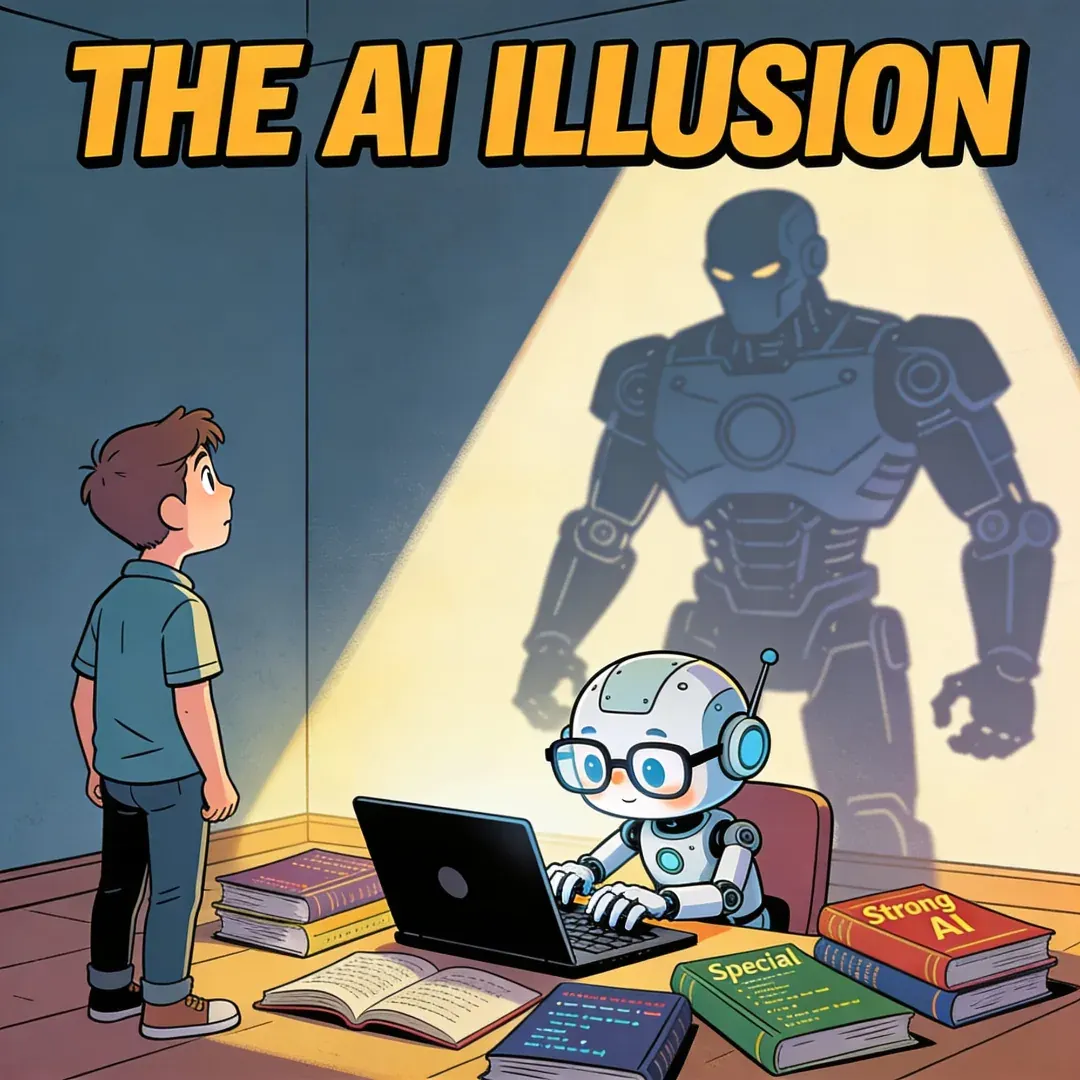
Myth: "This AI is already as intelligent as a human"
Reality
Systems like ChatGPT or Gemini are specialized AI models. They are optimized to process and generate content - such as text, code, images, or speech. Despite their versatility, they remain fundamentally limited to these classes of tasks. So-called strong AI (AGI), which can understand and solve problems flexibly across domains like a human, does not yet exist.
The key difference
Specialized AI: Delivers very strong results within clearly defined tasks, such as writing, summarizing, or structuring information. These abilities are based on statistically learned patterns and relationships from large datasets - not on intrinsic goal understanding or conscious contextual awareness.
Strong AI (AGI): Would act flexibly regardless of the application, transfer knowledge across domains, and pursue goals autonomously. It could, for example, master strategic games, make complex everyday decisions, and understand long-term relationships, all within a unified cognitive system.
An important nuance
The distinction is not binary. Modern AI systems are increasingly evolving toward multimodal and broadly applicable models. However, they still lack general, context-independent intelligence.
Current AI systems achieve their capabilities primarily through scaling (data, compute, model size) and optimization. They are highly powerful tools, but not universal problem-solvers in the sense of human intelligence.
Conclusion
Using AI effectively requires a clear understanding of its strengths and limitations. It is excellent for supporting well-defined tasks, but should not be uncritically used as a substitute for human judgment or responsibility.
This blog post is part of the ‘AI Myths’ series. You can find all other posts here.